
Cystic Acne, Hormonal Acne or PCOS? The Truth About Acne, What Causes It, and What Actually Helps
Updated: Oct 8
Rooted Wisdom Botanical Brief™
By Heather Nature, Founder & Formulator, Petal & Root®
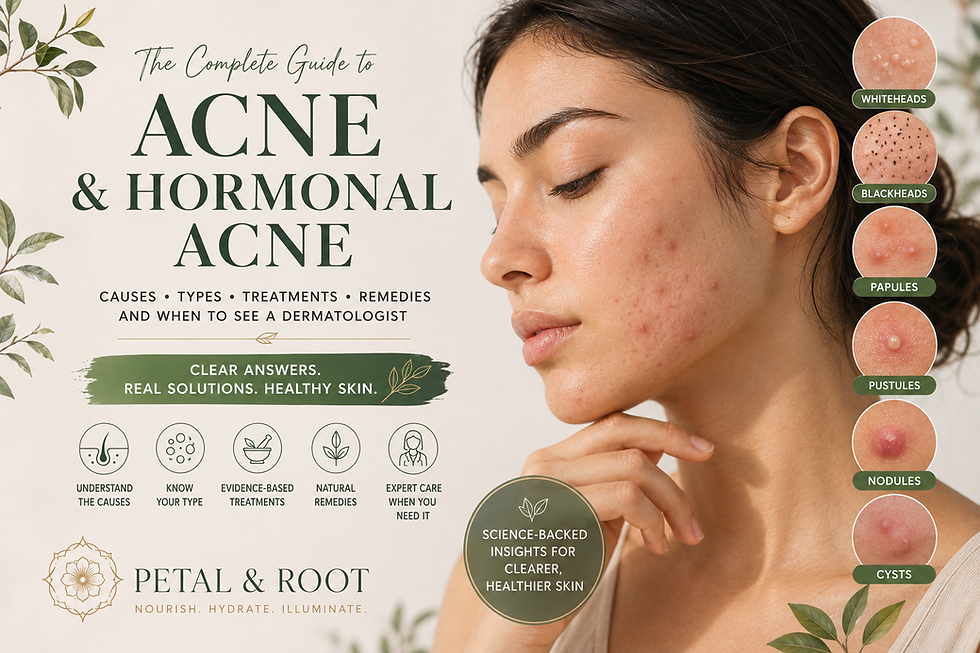
Your acne may be telling you something, but it may not be saying what you think.
A pimple seems simple enough. A clogged pore. A little redness. Maybe a whitehead that disappears in a few days. But acne is considerably more complicated than that. Some people develop tiny blackheads across the forehead. Others experience recurring breakouts around the chin and jaw. Some develop deep, painful lumps that seem to live beneath the skin for weeks. Others suddenly develop acne in adulthood after years of relatively clear skin.
And then there is the phrase “polycystic acne.”
Is it cystic acne? Hormonal acne? Acne caused by polycystic ovary syndrome (PCOS)?
First, What Does “Polycystic Acne” Actually Mean?
“Polycystic acne” is not a standard medical diagnosis. People generally use the term to describe either cystic acne or acne associated with polycystic ovary syndrome, or PCOS.
Those are two different things.
Cystic or nodulocystic acne
Nodules and cysts are deep inflammatory acne lesions that develop beneath the surface of the skin. They can be painful and are more likely than superficial acne to result in permanent scarring.
Acne associated with PCOS
PCOS is a hormonal and metabolic condition. Acne can be one of its symptoms, particularly when it occurs alongside other signs such as irregular menstrual cycles, excess facial or body hair, or other evidence of androgen excess.
Having cystic acne does not mean you have PCOS. And having PCOS does not mean you will automatically develop cystic acne. In fact, the 2023 International Evidence Based PCOS Guideline notes that acne by itself is a relatively weak predictor of biochemical hyperandrogenism, meaning acne alone cannot tell you that you have PCOS.
What Actually Causes Acne?
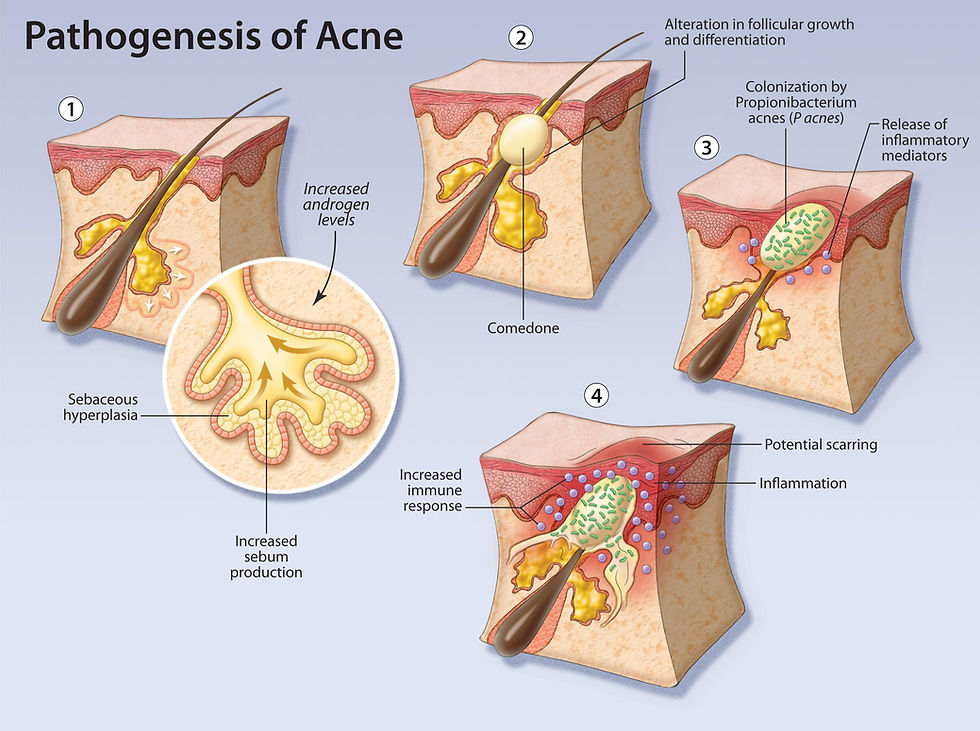
Acne is a chronic inflammatory condition involving the pilosebaceous unit, the hair follicle and its associated oil gland.
Several interacting processes contribute to acne, including:
1. Increased sebum production
Sebaceous glands produce an oily substance called sebum. Hormonal signaling, particularly involving androgens, can stimulate these glands and increase sebum production.
2. Abnormal follicular cell shedding
Skin cells inside the follicle can accumulate abnormally instead of shedding normally. Combined with sebum, this can contribute to a clogged follicle.
3. Changes in the follicular microbial environment
Cutibacterium acnes, commonly called C. acnes, is a normal resident of human skin. Acne is not simply an infection caused by having “bad bacteria.” Changes within the clogged follicle can create an environment in which C. acnes contributes to inflammation.
4. Inflammation
Once the follicle becomes inflamed, the lesion can progress from a microscopic clogged follicle into visible acne such as a papule, pustule, nodule, or cyst. This is why acne isn't simply a problem of “dirty skin.” And it is also why aggressively scrubbing your face is not the solution.
The 6 Main Types of Acne

1. Whiteheads
Whiteheads are closed comedones. Oil and dead skin cells accumulate inside the follicle, creating a small raised bump that appears white or flesh colored.
2. Blackheads
Blackheads are open comedones. The dark color isn't dirt. The material inside the open follicle undergoes changes that produce its characteristic dark appearance. So scrubbing harder isn't the answer.
3. Papules
Papules are small, raised inflammatory bumps. They generally don't contain visible pus.
4. Pustules
Pustules are inflamed lesions containing visible pus.
5. Nodules
Nodules are deeper, firm inflammatory lesions. They can be painful and can persist for weeks.
6. Cysts
Cysts are deep inflammatory acne lesions that contain pus. Nodules and cysts are the forms of acne that deserve particular attention because they can produce permanent scarring.
Why Do Some People Get Acne While Others Don't?
There isn't one single cause. Acne develops from a combination of biological and environmental factors.
Puberty
Acne commonly begins during puberty because hormonal changes stimulate the sebaceous glands and increase sebum production.
Genetics
If close relatives have a history of significant or deep, scarring acne, your own risk can be higher.
Hormonal fluctuations
Hormonal changes can contribute to acne around:
Menstruation
Pregnancy
Perimenopause
Menopause
Starting or stopping hormonal contraception
Adult acne can persist into the 30's, 40's, and 50's, and adults can also develop acne for the first time. Adult acne is particularly common among women.
Stress
Stress has been associated with acne flare-ups. The relationship is complex and involves hormonal and inflammatory signaling. Stress should therefore be viewed as a potential aggravating factor, not the sole cause of acne.
Medications
Certain medications can contribute to acne or make existing acne worse. If you suspect a medication is contributing to your acne, do not stop taking it on your own. Talk to the healthcare professional who prescribed it.
Skincare and hair products
Some products can contribute to clogged pores or irritation. For acne-prone skin, look for products labeled:
Non-comedogenic
Oil-free
Non-acnegenic
Won't clog pores
Friction, heat and pressure
Repeated friction, pressure, heat, or occlusion can contribute to acne mechanica. This can happen with things such as helmets, chin straps, tight clothing, masks, sports equipment, or other objects that repeatedly rub against the skin.
Hormonal Acne: Is Your Jawline Trying to Tell You Something?
Hormonal acne is often discussed in connection with the chin, jawline and lower face.
Adult female acne can show more inflammatory lesions around the lower face, including the chin and jawline. However, location alone cannot diagnose hormonal acne.

A breakout along your jawline doesn't automatically mean you have a hormone imbalance. A recurring pattern can be a clue, particularly when breakouts consistently occur around menstruation or are accompanied by other hormonal symptoms. But acne needs to be considered alongside the rest of the clinical picture.
When Acne Could Be a Clue to PCOS
PCOS is different from ordinary hormonal fluctuations. According to the American College of Obstetricians and Gynecologists, signs associated with PCOS can include:
Irregular or infrequent menstrual periods
Higher than normal androgen levels
Excess facial or body hair
Severe acne or acne that begins after adolescence and doesn't respond to usual treatment
Oily skin
Acanthosis nigricans, which can appear as thickened, velvety, darker skin
Difficulty becoming pregnant
Not everyone with PCOS has every symptom. The 2023 International PCOS Guideline also emphasizes that acne alone is not a strong enough indicator of biochemical hyperandrogenism. So don't diagnose yourself with PCOS because you suddenly developed chin acne. But if you're experiencing persistent acne plus irregular periods, excess facial hair, scalp hair thinning, or other signs of androgen excess, it is reasonable to discuss those symptoms with a qualified healthcare professional.
When “Acne” Isn't Actually Acne
Not every red bump, pustule, or cluster of bumps is acne. Several other skin conditions can look remarkably similar.
These include:
Perioral dermatitis
This can create small acne-like bumps around the mouth and sometimes around the nose or eyes.
Folliculitis
Inflammation of the hair follicles can resemble acne.
Rosacea
Rosacea can produce inflammatory bumps and pustules that are sometimes mistaken for acne.
Hidradenitis suppurativa
This is a chronic inflammatory condition that can cause painful nodules and abscess-like lesions, commonly in areas where skin rubs together.
Acne mechanica
Friction, pressure, heat and occlusion can produce acne-like breakouts. The treatments for these conditions can be very different from conventional acne treatment.
If something looks like acne but stubbornly refuses to behave like acne, get it evaluated.
Sometimes the problem isn't that your acne treatment isn't strong enough. Sometimes you're treating the wrong condition.
Acne Doesn't Just Affect Teenagers
Acne can affect people of virtually every age. It is extremely common during adolescence, but it can continue well into adulthood or appear for the first time in adulthood. The AAD notes that some adults continue experiencing acne into their 30's, 40's and 50's, with adult acne particularly common among women. And acne isn't limited to one skin tone. People with darker skin tones can be particularly susceptible to post-inflammatory hyperpigmentation, the dark marks that remain after inflammation has resolved.
That means the goal isn't simply: “Get rid of the pimple.”
It is also: “Control inflammation before it leaves a lasting mark.”
Acne Can Affect Much More Than Your Skin
Acne is sometimes dismissed as something everyone simply “grows out of.” That's not the whole story. Acne can affect self-esteem, social interactions, confidence and quality of life. Research has also associated acne, particularly more severe acne, with increased rates of depression and anxiety. And acne scars can remain long after the breakout itself is gone.
That is one reason early, appropriate treatment matters.
What Actually Helps Acne?
The right treatment depends on what kind of acne you have and how severe it is. There is no single acne treatment that works equally well for everyone.
Blackheads and whiteheads
Common evidence based options include:
Salicylic acid
Adapalene
Other topical retinoids
These can help prevent and treat clogged follicles.
Mild inflammatory acne
Common options include:
Benzoyl peroxide
Salicylic acid
Adapalene
Azelaic acid
Treatment should be introduced appropriately and consistently rather than layering several irritating actives together.
Persistent adult or hormonal acne
Depending on the individual, a dermatologist may consider topical or systemic treatments, including hormonal therapies.
For people with PCOS, treatment may also involve addressing the underlying hormonal condition. Combined hormonal contraceptives can improve acne in appropriate patients, but they are medical treatments with contraindications and should be selected with a healthcare professional.
Deep nodules and cysts
This is where DIY experimentation should stop. Large, painful, deep acne lesions are much less likely to respond adequately to ordinary over the counter skincare and are more likely to scar. A dermatologist can determine whether prescription treatment, injections, oral medication, or other therapy is appropriate. Current NICE guidance includes topical and oral treatments and specialist management for more severe acne, and the guideline was most recently updated April 30, 2026.
Natural Ways to Soothe Acne Prone Skin
Here's where we need to be honest about the word natural. Natural skincare can absolutely have a place in an acne conscious routine. But natural does not automatically mean effective or gentle.
The current evidence for herbal and complementary acne therapies is limited. NCCIH notes that there isn't enough evidence to recommend most herbal or complementary approaches as established acne treatments. So let's separate soothing and supportive care from actual acne treatment.
1. A Warm Compress for a Deep, Painful Pimple
This is one natural, low-tech remedy that dermatologists actually recommend. Apply a clean, warm, damp washcloth for 10 to 15 minutes, up to three times daily. This can help bring a deep lesion closer to the surface and provide soothing relief.
Then comes the hardest part: leave it alone. Don't squeeze it. Don't dig at it. Don't attack it with a needle. Picking or squeezing can increase the risk of infection, discoloration and scarring.
2. Gentle Cleansing
Acne prone skin does not need to be scrubbed aggressively. Use a gentle cleanser and avoid excessive friction. The goal is to remove excess oil, makeup, sunscreen and debris without creating unnecessary irritation. Overly aggressive cleansing can make acne prone skin more irritated and harder to tolerate. NICE specifically recommends gentle skin care rather than harsh washing or abrasive approaches.
3. Support the Skin Barrier
This is one of the most important principles in acne skincare. Many effective acne ingredients can cause dryness or irritation. A suitable moisturizer can help the skin tolerate acne treatments and maintain a healthier barrier. Look for lightweight, non-comedogenic formulations if you are prone to clogged pores.
Acne prone skin does not need to be stripped of every molecule of oil.
4. Aloe Vera: Soothing, Not an Acne Cure
Aloe can feel cooling and soothing on irritated skin. But there is an important distinction:
Aloe is a soothing skincare ingredient, not a proven primary treatment for acne. Don't take an ingredient's ability to calm irritated skin and turn that into a claim that it treats the underlying disease. That's how skincare misinformation starts.
5. Colloidal Oatmeal: Barrier Support
Colloidal oatmeal is another useful supportive ingredient for irritated skin. Its role here is primarily soothing and barrier support, not eliminating acne lesions. This can be especially useful when someone's acne routine has become too aggressive and the skin is dry, tight or irritated.
What About Tea Tree Oil?
Tea tree oil is one of the more interesting natural acne ingredients because there is some evidence suggesting topical tea tree oil may help acne. But the evidence is limited and not strong enough to place tea tree oil in the same category as established acne treatments.
NCCIH notes that the available evidence is limited and that tea tree oil can cause irritation, burning, stinging, dryness or allergic contact dermatitis. If used topically, it should be appropriately formulated or diluted.
Do not apply undiluted essential oil directly to your face.
And tea tree oil should never be swallowed.
Natural Acne Hacks You Should Skip
Some of the most viral acne remedies are also some of the worst.
Lemon juice: Lemon juice is acidic and can irritate the skin. It has no place as a DIY acne treatment.
Baking soda: Baking soda is alkaline and can be irritating to the skin. There is no good reason to use it as a facial acne treatment.
Toothpaste: Despite the enduring internet myth, toothpaste is not an acne treatment. The AAD specifically advises against it because ingredients intended for oral care can irritate or harm facial skin.
Undiluted essential oils: “Natural” is not synonymous with “non-irritating.” Essential oils can cause irritation and allergic contact dermatitis.
Aggressive facial scrubs: Acne is inflammatory. Scrubbing inflamed skin harder does not magically remove the underlying cause.
Popping cysts: This can increase inflammation and the risk of discoloration and scarring.
What About Diet?
This is another area where social media has turned a complicated subject into a simple answer.
“Cut dairy.”
“Stop eating sugar.”
“Go gluten-free.”
“Your acne is caused by insulin.”
The reality is considerably more nuanced.
Some research suggests that higher glycemic dietary patterns may influence acne in some people, but the evidence is not strong enough to prescribe one universal acne diet. Current NICE guidance does not recommend a specific diet as an acne treatment.
The sensible takeaway? Eat a generally nutritious, balanced diet. If you consistently notice that a particular dietary pattern appears to coincide with your breakouts, discuss that pattern with an appropriate healthcare professional rather than eliminating large categories of food based solely on social media advice.
Don't Build a 12 Step Acne Routine
One of the biggest mistakes in acne skincare is doing too much.
Someone sees a breakout and immediately reaches for:
Salicylic acid
Benzoyl peroxide
Retinol
Glycolic acid
A clay mask
A scrub
Tea tree oil
An exfoliating toner
A spot treatment
A peel
And then wonders why their face is red, tight, burning and peeling. More actives do not necessarily mean better results. In fact, excessive irritation can make your routine harder to tolerate. A simple routine is often a much better starting point.
Morning
1. Gentle cleanser
2. Appropriate acne treatment, if needed
3. Non-comedogenic moisturizer
4. Broad-spectrum SPF 30+ sunscreen
Evening
1. Gentle cleanser
2. Appropriate acne treatment
3. Moisturizer
Give a treatment time to work before deciding it has failed. The AAD notes that acne treatments generally require consistent use over several weeks, often 6 to 8 weeks, to assess improvement.
Sunscreen Still Matters
Especially if you're dealing with post-acne discoloration. Inflammation can leave behind dark marks, and UV exposure can contribute to persistent pigmentation. The AAD recommends broad-spectrum SPF 30 or higher and notes that some acne treatments can increase sun sensitivity. For acne prone skin, look for products labeled non-comedogenic or “won't clog pores.”
When Should You See a Dermatologist?
Don't wait until acne has caused years of inflammation and scarring.
Consider professional evaluation if you have:
Deep, painful nodules
Cysts
Acne that is leaving scars
Persistent post-acne dark marks
Acne that isn't improving with appropriate OTC treatment
Sudden severe adult onset acne
Persistent acne accompanied by irregular periods or signs of androgen excess
Breakouts that don't behave like ordinary acne
Acne that is significantly affecting your emotional wellbeing
And remember: You don't have to wait until acne becomes severe to see a dermatologist.
The AAD specifically notes that mild acne can often be treated at home, while large, painful, deep lesions and scarring acne generally require professional care.
The Bottom Line
Acne isn't simply a problem of dirty skin. It isn't always caused by bacteria, hormones, or by your diet. And cystic acne does not automatically mean PCOS. Acne develops through several interacting biological processes involving sebum, follicular plugging, microbial changes, inflammation, hormones, genetics and environmental influences. That's why treating every breakout the same way doesn't make sense.
The first step is figuring out what you're actually dealing with.
Is it a blackhead? A whitehead? Inflammatory acne? A deep nodule? A cyst? Hormonal acne? Acne associated with PCOS? Or perhaps something that only looks like acne?
Once you know what you're dealing with, you can choose a treatment strategy that makes sense.
Acne at a Glance
What you're dealing with | What may help |
Blackheads | Salicylic acid, adapalene or another appropriate retinoid |
Whiteheads | Salicylic acid, adapalene or another appropriate retinoid |
Papules | Benzoyl peroxide, salicylic acid, adapalene, azelaic acid |
Pustules | Benzoyl peroxide, salicylic acid, adapalene, azelaic acid |
Recurring lower face acne | Consider hormonal contribution, but location alone is not diagnostic |
Acne + irregular periods or excess facial hair | Discuss possible PCOS or another hormonal condition with a healthcare professional |
Deep painful nodules | Dermatologist |
Cysts | Dermatologist |
Acne scars | Early acne treatment and professional evaluation |
Post-acne dark marks | Acne control, sunscreen and appropriate pigment-focused treatment |
Irritated acne-prone skin | Gentle cleansing, moisturizer and barrier support |
One deep painful pimple | Warm compress, hands off, appropriate acne treatment |
A Note About Pregnancy
If you are pregnant, trying to become pregnant, or breastfeeding, don't automatically assume an over the counter acne ingredient is appropriate for you. The AAD specifically recommends consulting a dermatologist before self treating acne during pregnancy or when trying to become pregnant.
Medical Disclaimer
This article is provided for educational purposes only and is not intended to diagnose, treat, cure or prevent any disease or medical condition. Acne can have many causes, and treatment should be individualized. Persistent, severe, painful, scarring or unusual breakouts should be evaluated by a qualified healthcare professional.
Stay radiant,


References and Further Reading
1. American Academy of Dermatology, Acne OverviewInformation on acne types, causes, scarring and evidence-based treatment approaches. American Academy of Dermatology, Acne Overview
2. American Academy of Dermatology, Acne Signs and SymptomsDescriptions of whiteheads, blackheads, papules, pustules, nodules and cysts. American Academy of Dermatology, Acne Signs and Symptoms
3. American Academy of Dermatology, Adult AcneAdult-onset acne, hormonal fluctuations, stress, genetics, medications and skincare products. American Academy of Dermatology, Adult Acne
4. American Academy of Dermatology, Acne Diagnosis and TreatmentEvidence-based acne treatments and conditions that can resemble acne. American Academy of Dermatology, Acne Diagnosis and Treatment
5. American Academy of Dermatology, Deep Painful PimplesHome care for nodular and cystic acne, including warm compresses and avoiding squeezing. American Academy of Dermatology, Deep Painful Pimples
6. American Academy of Dermatology, Adult Acne TreatmentOTC acne actives, treatment timelines and when professional treatment is appropriate. American Academy of Dermatology, Adult Acne Treatment
7. NICE, Acne Vulgaris: Management, NG198Current clinical guidance for acne treatment, skincare, dietary evidence and specialist referral. The guideline was last updated April 30, 2026. NICE, Acne Vulgaris Management
8. American College of Obstetricians and Gynecologists, Polycystic Ovary SyndromeSymptoms, androgen excess, acne and other clinical features associated with PCOS. ACOG, Polycystic Ovary Syndrome
9. International Evidence-Based Guideline for the Assessment and Management of PCOS, 2023Current international guidance concerning clinical hyperandrogenism and the significance of acne in PCOS assessment. 2023 International PCOS Guideline
10. NCCIH, Skin Conditions and Complementary Health ApproachesEvidence and safety information regarding complementary approaches, including tea tree oil and acne. NCCIH, Skin Conditions and Complementary Health Approaches
11. NCCIH, Tea Tree Oil: Usefulness and SafetyEvidence and safety considerations for topical tea tree oil. NCCIH, Tea Tree Oil
